
Quick answer: You can give your children a strong financial education by learning alongside them, explaining everyday choices and letting them practice with small amounts of money. Start with earning, spending, saving and giving. You do not need a perfect financial history or a finance degree to make money a thoughtful, normal part of family conversation.
Start with honesty, without handing children your worries
If money was never explained to you, teaching it can feel like trying to lead a hike on a trail you have not walked. Begin with a sentence that makes room for growth: ‘I’m learning to handle money more thoughtfully, and I want us to learn together.’ That models humility rather than pretending to know everything.
Keep adult responsibilities with the adults. Children can understand that families make spending choices without hearing every detail of a debt balance or feeling responsible for fixing it. Say, ‘We’re choosing groceries and our savings goal before this purchase,’ rather than, ‘You cost us too much.’ Your child needs an invitation to learn, not a burden to carry.
Teach one idea through one real decision
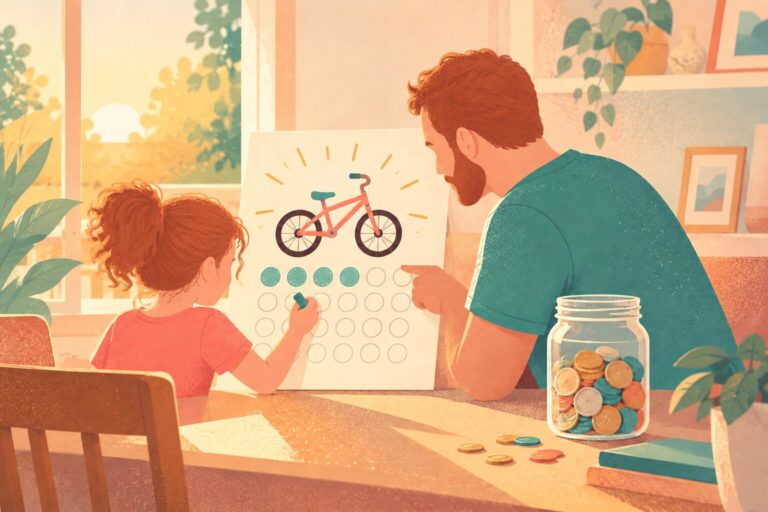
Choose a decision your child already understands: whether to buy a snack now or save for a book. Count the available money, name both choices and ask what each choice means. If your child spends the money, let the smaller consequence teach something. Resist turning every purchase into a lecture or rescuing every disappointment.
For younger children, use coins, play money or a drawing. For older children, write down a goal, compare prices and track progress. Skills grow through repeated use. The aim is to help children explain their choice: ‘I chose this because…’ That reasoning matters more than choosing whatever a parent would choose.
Connect money skills with the kind of person you hope to raise
A Christian approach connects practical skills with honesty, generosity, patience and contentment. Luke 16:10 emphasizes faithfulness in small responsibilities. It does not promise that a child who saves well will become rich. It invites your family to practice care with what is already entrusted to you.
Talk about what money can help your family do, and what it cannot provide. Friendship, belonging and a person’s worth do not depend on a bank balance. When you teach kids about money, include time, effort and service in the conversation so financial learning stays connected to life.
Try a ten-minute weekly money conversation
Choose one evening and ask three questions: What money decision did you make this week? What did you learn? What will you try next week? Let each child bring a coin, receipt or drawing. Share one age-appropriate example of your own. Finish by choosing one small action, such as saving a dollar or checking a price. Keep the routine short enough that your family can repeat it.
Keep Learning Together
Explore financial literacy activities for kids at home, or how children can earn money at home.
If you would like a guided starting point, try the free Money Explorers sample lesson and learn alongside your children. Try the free sample lesson or view the Money Explorers course.
Frequently Asked Questions
What if I have made serious money mistakes?
You can teach the lesson without describing every adult detail. Explain the habit you are changing, such as planning before spending, and show the new behavior consistently.
Do children need an allowance to learn about money?
No. Gift money, pretend purchases, grocery decisions and family giving all offer practice. An allowance is one possible tool, not a requirement.
Where should our family begin?
Begin with one everyday choice and one manageable routine. Add saving, giving and earning as your child becomes comfortable explaining simple decisions.