
Budgets and Banks
About 14 minutes, plus hands-on activity and discussion.
Think About It
Imagine you just got $20 for your birthday. If you spend it right away, you might not have enough left for something more important you really want. That’s why a budget matters. And keeping money in a bank helps you stick to your plan.
Let’s Learn
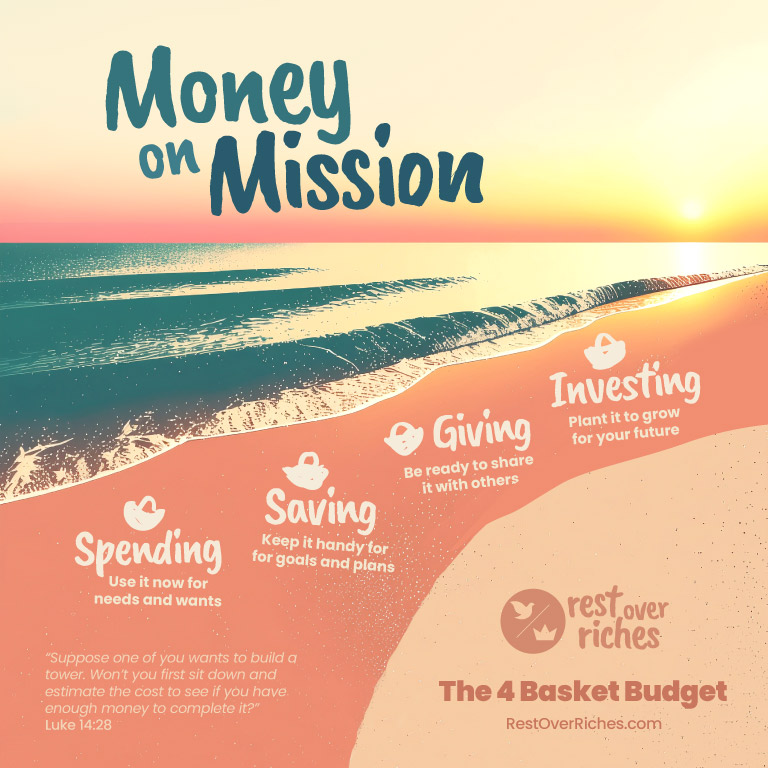
Money on Mission: The Four Basket Budget
A Budget Is a Plan for Your Money
A budget helps you decide what to do with the money you already have and any money you will get in the future. Without a budget, money can slip away quickly, and you may not even know where it went. With a budget, you know exactly where your money is coming from, and where it is going. This is very important.
When we talk about a budget, it really comes down to two parts:
- Income: money you make.
- Jobs for your money: money you spend, save, give, and invest.
Every dollar of income has to have a job. That’s where the four baskets come in.
Step 1: Cover Your Needs (Spending)
The first job of your money is to meet your needs. Things such as food, shelter, clothes, school supplies, and transportation are examples of needs. This part of the budget is called spending on needs. These are things you must spend your money on before anything else.
Income – Spending on Needs = What’s Left
Once your needs are covered, you move to Step 2.
Step 2: Give Jobs to What’s Left
The money that’s left after covering your needs is ready for the other baskets. Each basket represents an important job your dollars can do:
- Saving: money set aside for upcoming goals like a bike, a trip, or new shoes. These are seeds you save now so you’ll have fruit later.
- Giving: money used to share with others. These are seeds you plant in others’ lives, and the fruit that grows is joy, blessing, and kindness.
- Investing: money planted to grow into more money for your future. These seeds multiply over time.
- Spending on Wants: money for fun things like toys, games, or treats. Spending on wants is good, as long as you’ve planned money for saving, giving, and investing first.
Example:
You earn $25 for mowing a lawn.
- Step 1: Spending on needs: $10 for a backpack for school.
- What’s Left: $25 – $10 = $15.
- Step 2: Put what’s left ($15) into each basket:
- Saving: $3
- Giving: $2
- Investing: $7
- Spending on wants: $3
- Summary: $3 + $2 + $7 + $3 = $15
- Step 3: Review. The total should equal your income, so every dollar has a job.
- Summary: $10 + $15 = $25
High five! You earned $25, and you put all $25 into the four baskets! You covered your needs, filled your baskets, and made a healthy budget. Every dollar has a job, and every seed has been planted in one of the four baskets.
This is a healthy budget!
Necessary and Discretionary Expenses
Spending is using your money to buy things. The things you spend money on are called expenses. Not all expenses are the same. Some expenses are needs, and some are wants.
Necessary expenses (needs) are things you have no choice but to pay for, such as food, shelter, clothes, school supplies, and transportation. Even for kids, this could be your school lunch or replacing worn-out shoes.
Discretionary expenses (wants) are optional things you don’t have to buy or do, such as toys, games, ice cream, or movies.
When you are low on money, it’s usually easier to not spend money on your wants than your needs. That’s why in Step 1, you spend money on your needs first, then in Step 2, you decide how much of what’s left to use for wants, saving, giving, and investing.
Why A Budget Matters
A budget makes sure you don’t run out of money, helps you cover your needs, and helps you reach your goals. It also reminds you that Saving, Giving, and Investing are just as important as Spending. By planning ahead, you make sure your money is on mission and growing the right kind of fruit for different needs: meeting today’s expenses, preparing for tomorrow, blessing others, and planting for the future.
Mia’s New Bike
Mia wanted a new bike. She got $20 each week for helping her neighbor with chores and sometimes extra birthday or holiday money from relatives. At first, she spent her money as soon as she got it. She bought things like snacks, small toys, and online games. The money was fun in the moment, but the bike still felt impossible to save for.
One day, her dad showed her how to make a budget. Together they wrote down four categories: Spend, Save, Give, and Invest. Mia decided she would put $2 each week into giving, $7 into saving for her bike, $5 for investing for college, and keep $6 for spending on small things.
At first, it was hard for Mia not to spend all her money right away. But after a few months, her savings grew, and she realized her plan was working. When her birthday came, she deposited her gift money straight into her savings, too. Finally, the day came when Mia had enough to buy the bike she had dreamed about. She even had money left over for a helmet!
What Mia Learned
Mia discovered that a budget doesn’t take away her fun, it actually gave her freedom. She still got to enjoy snacks and games, but she also reached a bigger goal by planning ahead. Her budget helped her balance her money so she could give, save, spend, and plan for later all at the same time.
Bank Basics and Benefits
A bank is more than just a building with a vault. It’s a place that keeps your money safe and helps you manage it wisely. Banks offer different kinds of accounts, tools, and cards that make handling money easier in everyday life. When you use a bank, you don’t have to keep all your cash at home where it could be lost or stolen. Instead, you can deposit your money into the bank, check how much you have in your bank account (your balance), and withdraw cash when you need it.
Banks also give you ways to save, spend, and even grow your money. From checking accounts that connect to debit cards, to savings accounts that earn interest, banks are designed to help your money do its job. Understanding how banks work means you can use them as a tool to keep your money safe and help it grow.
Checking Accounts
A checking account is for the money you use often. You can write checks, pay for things online, or use a debit card that connects to this account. When you use your debit card at a store, the money comes directly out of your checking account. It’s like spending cash, but safer and easier to track.
Savings Accounts
A savings account is for money you want to keep for later. When you leave money in a savings account, the bank may give you interest. Interest is extra money the bank adds to your account as a reward for saving. Over time, your savings can slowly grow just by staying there.
Deposits and Withdrawals
When you deposit money, you’re putting it into the bank. You can bring cash and hand it to a teller or use an ATM. If someone gives you a check, you can deposit it into your account or cash it to turn it into money you can hold.
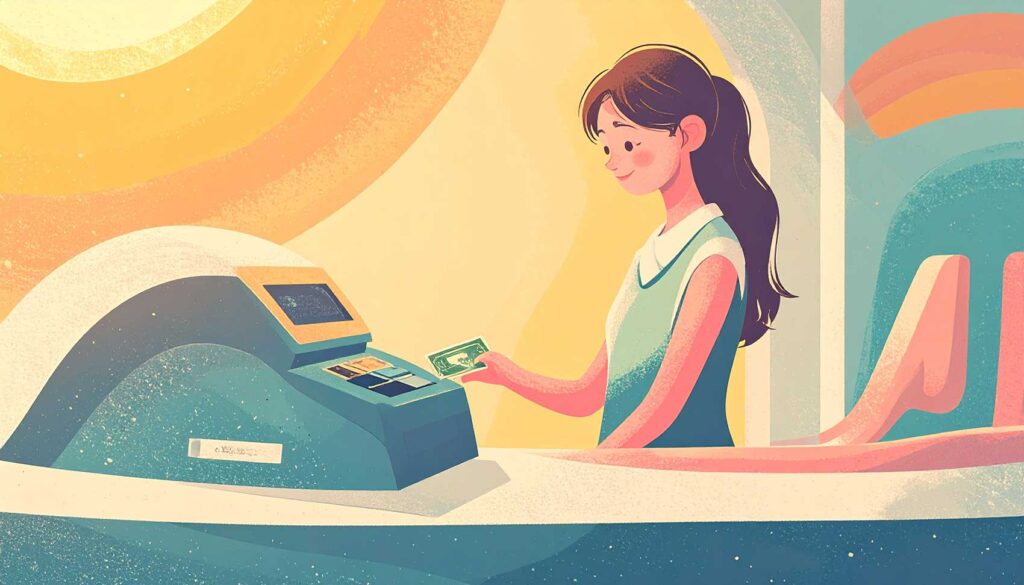
When you withdraw money, you’re taking it out of the bank. You might withdraw by getting cash at an ATM, visiting the bank counter, or moving money from one account to another online.
Online Banking and Apps
Today, most banks also have apps and websites where you can check your balance, move money, or even deposit checks by taking a picture. If you’re using an app like Greenlight, that app works as your bank account. Greenlight holds your money the same way a bank does and lets you spend, save, and track what you’re doing with it.
Banks in America
There are nearly 4,000 banks in the United States, plus a few hundred savings associations. Some are small community banks, while others are very large national banks.
The biggest banks include JPMorgan Chase, Bank of America, Wells Fargo, and Citigroup. Together, the top five banks hold more than half of all the money in U.S. accounts. That means millions of people trust these banks to manage and protect their money.
Budgets and Banks Together
Your budget is the plan. Your bank is the treasure chest that guards your plan. When you use both, you become a wise money manager who is ready for today and tomorrow.
Words to Know
A budget is a plan that helps you decide how to use your money.
Necessary expenses are the things you must pay for to live and stay healthy, such as food, housing, clothes, and transportation.
Discretionary expenses are the extra things you choose to spend money on for fun or enjoyment, such as toys, games, eating out, or entertainment.
A bank is a safe place that keeps your money and helps you manage it.
A checking account is a bank account you use for everyday spending and paying for things.
A savings account is a bank account where you keep money you want to save for the future.
Interest is extra money the bank adds to your account as a reward for saving.
Let’s Play!
Flip the Card
Instructions: There are 5 scenarios below. Read the question on each card and then flip it to see if you’re right!
Bible Time
“Suppose one of you wants to build a tower. Won’t you first sit down and estimate the cost to see if you have enough money to complete it?”
—Luke 14:28
Jesus used this example to explain the importance of planning ahead. If someone wants to build a building, they have to think about the cost first. If they don’t, they might run out of money before the building is finished.
In the same way, when we plan how to use our money with a budget, we are making sure we don’t run out before we reach our goal. Budgeting is like counting the cost before building, it helps us use what God has given us wisely.
With Your Grown-up
If a grown-up or parent is nearby, spend a minute to discuss one or more of these topics.
Hands On
Put learning into action! Download the activity and dive into a fun, practical way to explore today’s lesson. A link to the budgeting calculator is in the activity, and also included below.
What we Learned
Today we learned that a budget is a plan that helps us decide how to spend, save, give, and invest. A bank is a safe place that holds our money and gives us tools like checking accounts, savings accounts, debit cards, deposits, and withdrawals. As stewards of the gifts God has given us, using both a budget and a bank helps us plan wisely and take care of the money He has entrusted to us.
Check Your Understanding
High-Five!
Hit play for your end-of-lesson video!