
Investing For Life
About 24 minutes, plus hands-on activity and discussion.

Think About It
Imagine you planted one little apple seed in the ground. You watered it, gave it sunlight, and waited. Years later, it grew into a big tree with hundreds of apples! Now imagine if you had buried that seed in a box under your bed, it would have stayed just one seed.
In this lesson, we’re going to learn what perspective is and why it matters, and how to actually invest your money so it has a chance to grow. One simple way to start is our 10/10/10 plan: invest $10 each month, then add $10 more every year, and stay invested, like leaving your seed in good soil. It begins tiny, but with patience and time the steady habit of investing a small amount of money can produce a much larger amount of money. By the end of today’s lesson, you’ll see how that $10 can grow into something much bigger than you can imagine today.
Let’s Learn
The Parable of the Talents
Jesus told a story about a master who was going on a long journey (Matthew 25:14–30). Before he left, he called three of his servants and gave each of them some money, called talents. One servant received five talents, another received two, and the last servant received one.
The servants who received five and two talents went right to work. They invested the money and made wise choices. The one with five talents doubled it and ended up with ten. The one with two talents also doubled his and ended up with four. But the servant who received just one talent was afraid of losing it. Instead of using it, he buried it in the ground and did nothing with it.
When the master came back, he asked each servant to give a report of what they had done with the money. He was very pleased with the first two. He told them, “Well done, good and faithful servant! Because you have been faithful with a little, I will trust you with much more.” But when he heard from the servant who buried his talent, he was disappointed. That servant had nothing to show, because he had not even tried to make the money grow.

When we invest what we have and let it grow, it can bless others and honor God. But if we hide what we have or waste it, it cannot grow.
The Power of Perspective

Once you’ve started investing, one of the hardest parts is staying invested and not selling your investment too soon. Remember the seed we talked about planting? If you keep digging it up to check on it, it will never grow. But if you leave it in the ground, water it, and wait patiently, it becomes a tree that produces fruit. Investing works the same way.
Once your money is planted, the best thing you can do is let it stay and grow.
The key that helps us keep our money invested is having the right perspective. Perspective means how we choose to look at something—zoomed in or zoomed out, short-term or long-term. The way we look at things makes all the difference.

Perspective + trend
There is one more important investing word to know: trend. A trend is the direction something is moving in. For instance, in the spring the weather is trending warmer because each week the temperature is usually getting higher. In the fall, the weather is trending cooler as the weeks go by and winter gets closer.
In investing, it is safest to invest in markets that are trending higher over the long-term.
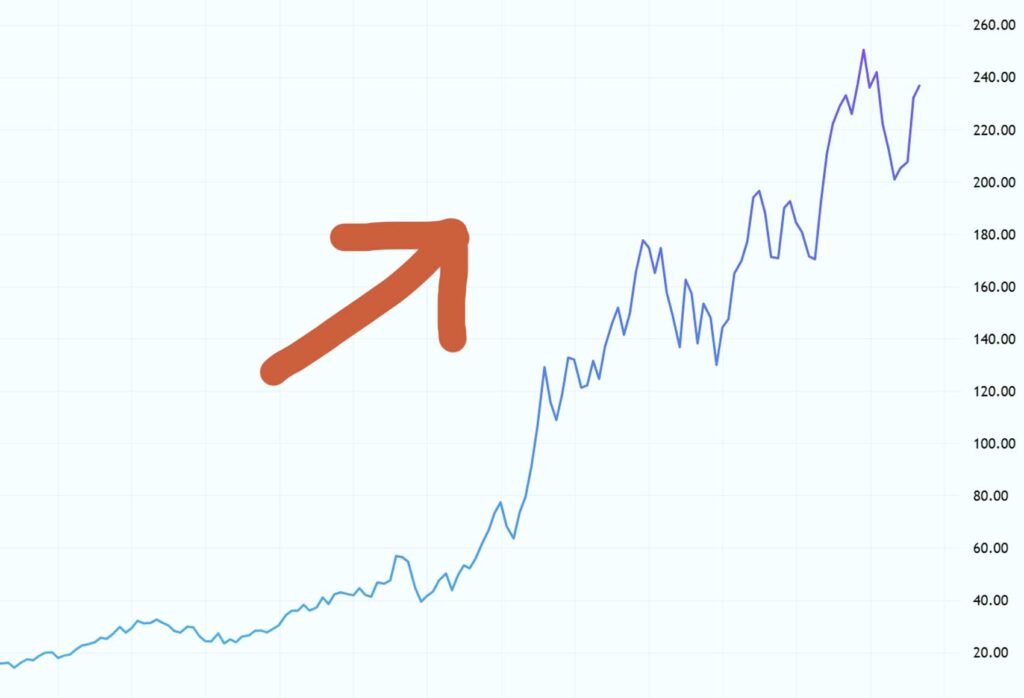
The chart below shows the stock price of Apple over 10 years from 2015 to 2025. This zoomed-out chart shows a clear upward trend, which gives us confidence that Apple’s stock has grown for a long time and may continue to grow. The trend could change, but looking at a longer time frame gives us confidence.
Now let’s zoom in on just four months in 2022, when Apple’s stock fell from $175 to $125. The short-term trend was clearly downward. But when we zoom back out to the 10-year view, we see those four months were just a small dip in a much bigger upward trend. With a long-term perspective, we realize that staying patient is the wiser choice.
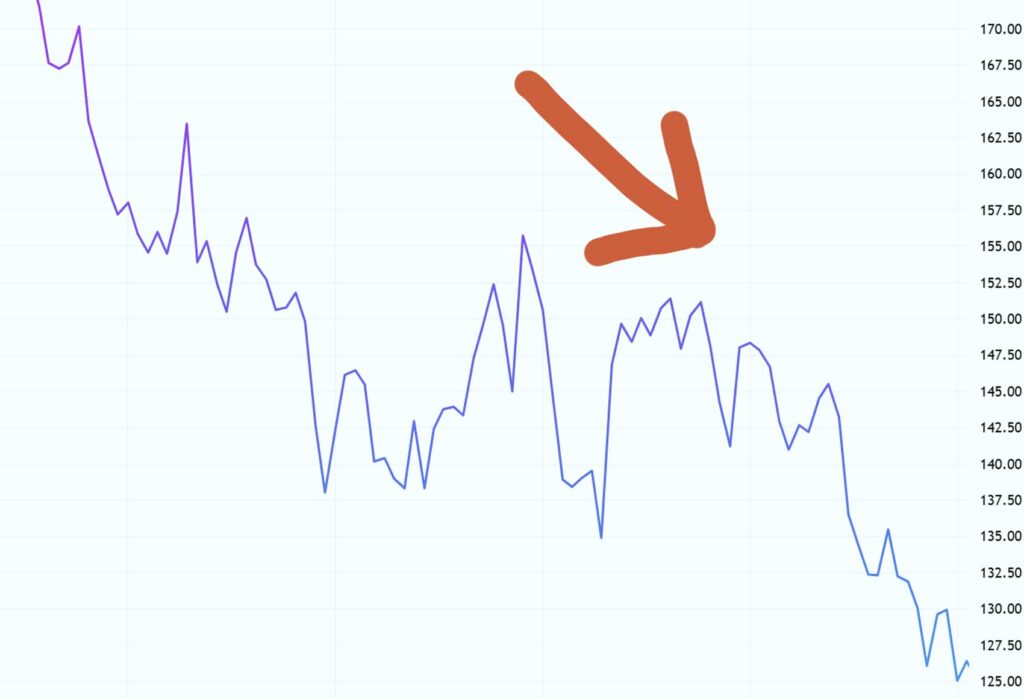
This teaches us something important: short-term drops can feel scary, but in the bigger picture they are often just small bumps along the way. A healthy long-term perspective reminds us that over the long run, the stock is likely to continue increasing in value.
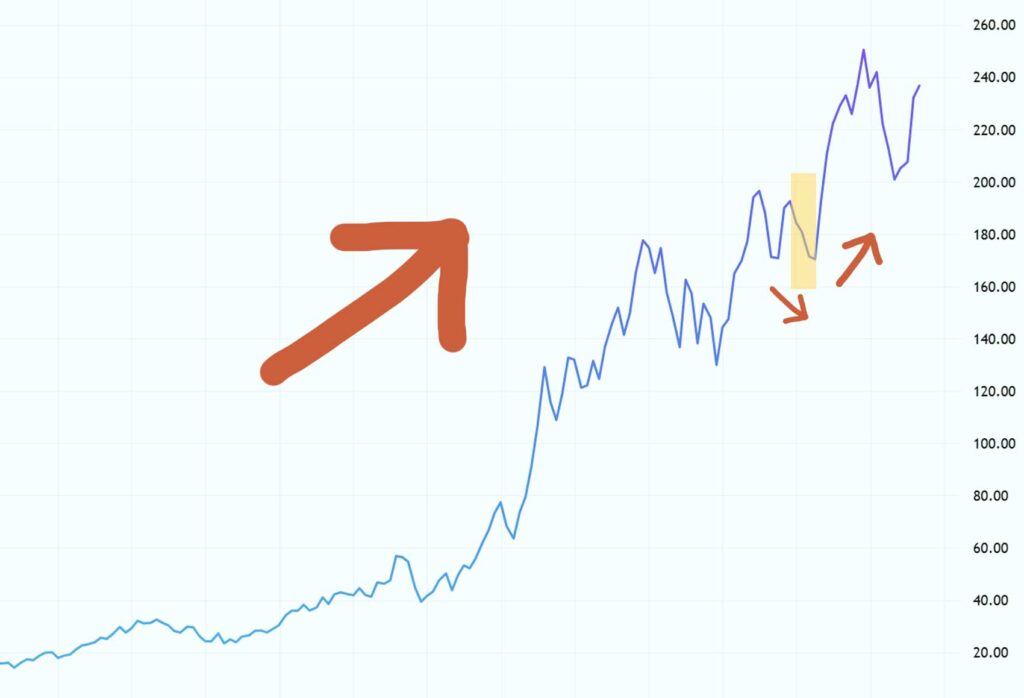
So if we buy Apple’s stock, for example, and see the price moving down, we don’t need to panic. Instead, we can stay patient, knowing that over a longer period of time the value is more likely to keep growing.
Do Investments always grow in value?

Money that is invested does not always grow. That is the risk that comes with investing. Sometimes money can go down instead of up. Think about planting a garden: most plants grow, but sometimes bugs, weeds, or bad weather hurt them. Some companies do not do well, and sometimes the stock market goes down for a while.
This is why it is important to spread out your investments instead of putting everything in one place.
Even though investing has ups and downs, history shows that over long periods of time, money usually grows if we stay patient.
What markets are most likely to grow in value?
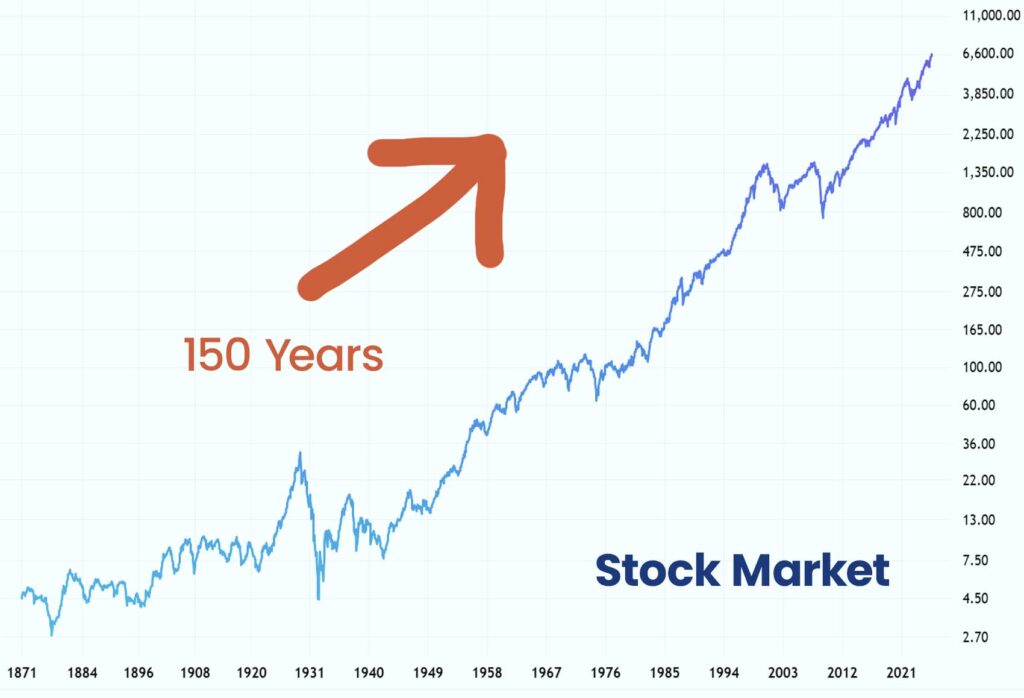
Over the last 150 years, the stock market has been one of the best places to invest. Despite many ups and downs, the long-term trend has always been upward. The S&P 500, a stock basket of the 500 largest American companies, is one of the clearest examples of this growth.
Real estate has also been a strong long-term investment. For well over 100 years, land and home prices in the U.S. have generally risen in value, even though there were times when prices dropped or stayed flat.
Gold has been valued for centuries, and over the last 200 years its price has risen significantly.
Collectibles are unique because they can include so many different items, from antique furniture to trading cards to coins. They may be harder to buy and sell and their value can be difficult to measure. But they can also be fun because there is something special about holding a valuable item in your hand.
Invest for Your Future
What you choose to invest in matters, but you can make it easier by diversifying. Diversification means “Don’t put all your eggs in one basket.” Spread your money across different types of investments—stocks, real estate, and maybe even collectibles. That way, if one basket struggles, the others may still grow.

The Bible gives the same wisdom. Ecclesiastes 11:2 says, “Invest in seven ventures, yes, in eight; you do not know what disaster may come upon the land.” Even thousands of years ago, God’s Word encouraged people to spread out their resources for safety and wisdom.
As Warren Buffett, one of the world’s most successful investors, once said: “Never depend on a single income. Make investment to create a second source.”
How to Buy Stocks, Real Estate, Gold, and Collectibles
Apps for Small Investments
So how do you actually buy an investment? Today it is easier than ever, even if you only have a small amount of money to start.
Some apps allow you to buy what are called fractional shares. Instead of paying for a whole share of a company’s stock, which might cost hundreds of dollars, you can buy just a small piece for only a few dollars. This makes investing possible for kids and beginners who want to start small.
Examples of apps for youth that allow fractional investing include Greenlight, Acorns, and Fidelity Youth Account. Parents should be the ones to open the account.
The Fidelity Youth Account does not have a monthly fee and is available for teens ages 13–18. However, it does not include family tools like chore tracking or payment management. Because of this, many families may want to keep using Greenlight or Acorns for those features while their kids are still at home. Fidelity Youth Account can still be a good option to introduce teens to investing without monthly fees, and then it automatically converts to a standard Fidelity account when the teen turns 18.
Alternatively, parents can use their own investment account and simply track which purchases are set aside for their children.
Stocks and Baskets of Stocks
For stocks and baskets of stocks, you can use the same platforms mentioned above or any other investment platform of your choice. Buying a basket of stocks, such as an index fund like those listed below, spreads your money across many companies at once instead of relying on just one.
Real Estate and Gold
Investing does not only mean buying stocks. You can also invest in things like real estate and gold, even without owning a house or a pile of gold bars. Real estate can be invested in through Real Estate Investment Trusts, which are traded on the stock market under ticker symbols just like stocks. Gold can be invested in by purchasing shares of a gold fund that tracks the price of gold.
Over the long term, gold and real estate have usually risen in value, though often more slowly than stock market funds.
Collectibles
Collectibles are usually bought and sold through online marketplaces such as eBay or specialty apps, at local stores, and at traveling events like card shows or comic conventions.
Ticker Symbols
A ticker symbol is a short code used to identify a stock or fund on the market. You can search for ticker symbols in your investing platform or app.
- VOO – Vanguard S&P 500 ETF. An S&P 500 fund, known for low fees and long-term growth.
- QQQ – Invesco QQQ Trust. This tracks the Nasdaq-100, which includes many of the largest technology companies like Apple, Microsoft, and Amazon.
- VNQ – Vanguard Real Estate ETF. This is a “basket” of many REITs, giving exposure to the whole real estate sector.
- GLD – One of the largest and most popular gold ETFs, directly tracking the price of gold.
The Power of Regular Investing
The real power of investing comes when you buy regularly over time. Making consistent purchases, such as adding twenty or fifty dollars every month, allows you to keep building your investment little by little. Over time, those small amounts can grow into something much larger because of compounding growth.
For example, if you invested twenty dollars a month for ten years, you would put in a total of $2,400. At the stock market’s historical average return of about seven percent per year, that $2,400 could grow to over $3,500. If you kept going for twenty years, your $4,800 of contributions could grow to nearly $10,500.
If you invested fifty dollars a month for ten years, you would put in $6,000. At the same average return, that could grow to about $8,800. If you kept going for twenty years, your $12,000 of contributions could grow to nearly $26,500.
That is the power of investing regularly and being patient. In this lesson’s hands-on activity, you will use a special calculator to see how adding money to your investing basket adds up and multiplies across the years.
The 10/10/10 Plan: Start Small, Grow Steady
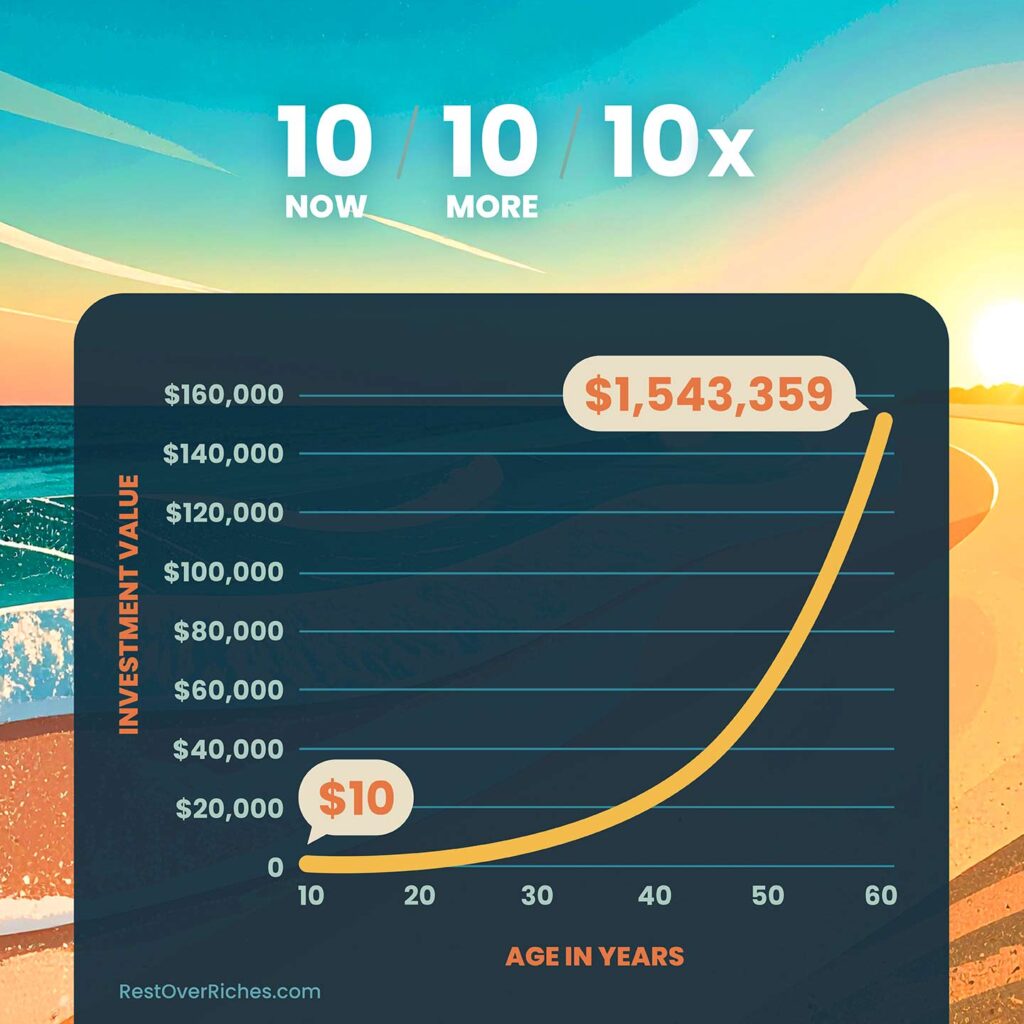
Investing isn’t about trying to guess the future, it’s about building good habits and staying consistent. It means practicing patience and growing a healthy money habit over time. The 10/10/10 plan makes it easy to start: invest $10 now and each month, then add $10 more every year, and keep going for the long run. Little by little, your money can grow, even multiply by ten times (10x) what you’ve put in! Small steps, practiced faithfully, can turn into something really powerful.
The power of consistency
Over long periods, the stock market has averaged about 10% per year. That means your investment basket’s value will roughly double about every seven years on average. Compounding means your money starts earning its own money, and time multiplies steady investment contributions. We don’t need perfect timing, we need a plan we can actually keep.
sustainable and attainable
This plan starts small on purpose! Ten dollars a month is an easy amount to begin with, and adding $10 more each year can grow right along with you as you get older, start doing chores, and then earn money from a job outside the home. Adding money to your investing basket can even happen automatically each month, so investing becomes a simple habit. And if one year it feels difficult to invest, that’s okay, just keep going with what you can. What matters most is staying consistent, not being perfect.
What about the teenage years?
Some years you might not be able to add the full $10, and that’s totally okay! The important thing is to keep the habit going. If you can only add part of it, keep doing your best. Parents can even help fill in the gap for a while, like if you invest $20 and they add $10 to make it $30. Then, when you start earning more from jobs at home, a summer job, or after graduation, you can pick back up with adding $10 or jump ahead to the goal amount for your age.
How it complements other investments
The 10/10/10 plan is meant to be a starting point that can grow a lot of fruit over a long time period. Because it begins small and grows slowly, it can keep going in the background while you work toward bigger goals later, like buying your first home, starting a business, or saving up for emergencies. The habit you start now keeps growing right along with you as you reach new stages in life.
In real life, this plan fits right in with everything else you’ll do as you grow up.
It’s easy to afford: The amount stays small enough that families can still save for things like a house or fixing up their home.
You can do both: This plan can keep growing while adults save for other goals too, like starting a business or investing in real estate.
No need to stop: You don’t have to pause this investment just because new goals appear. It’s designed to grow quietly in the background.
You can mix it up: As you get older, you can split your money into different “baskets” to practice what investors call diversifying—like putting most in a big basket of stocks, a little in real estate, and a tiny bit in something fun to explore.
As your investment grows, you’ll learn how to balance and adjust those baskets, which are the same skills adults use for big goals like buying a home and investing for retirement. The big idea? Keep planting and watering your seed. Don’t dig it up!
A picture of patience
Imagine a 10-year-old who starts investing just $10 a month. Each year, they add $10 more to their monthly amount and keep going for 50 years. By age 59, they would be investing $500 a month. Altogether, they would have put in about $150,000 and if their money grew at an average of around 10% a year, their account could grow to about $1.5 million when they turn 60 years old.
Of course, no one can predict exactly what the market will do because it goes up and down, but this shows how time and steady habits can make a huge difference. Staying consistent really is the secret superpower.
How to do it (simple steps)
Start: choose a small monthly amount. $10 is enough to begin.
Stay: keep contributing every month so compounding isn’t interrupted.
Add: increase that monthly investment amount by $10 on the same date each year (birthday or back-to-school is easy to remember).
Try it.
Open the 10/10/10 investment calculator and put in your starting age and monthly amount. Change the numbers and see how your investment value changes over time.
Faith and perspective
When we plant and water faithfully, God provides the increase in His timing. The Bible warns against chasing quick riches and celebrates steady, honest growth. A long-term perspective helps us stay calm when the market decreases in value, remembering that seeds grow best when we leave them in the ground.
Words to Know
Perspective is how you look at something, either close up (short-term) or zoomed out (long-term).
A trend is the direction something is moving in over time, like up, down, or sideways.
Diversification means spreading your money across different types of investments so you are not depending on just one.
A ticker symbol is the short code of letters used to identify a stock or fund on the market.
Let’s Play!
Drag the Words Game
Instructions: Drag the correct word into each sentence.
Bible Time
“Dishonest money dwindles away, but whoever gathers money little by little makes it grow.”
—Proverbs 13:11
The Bible teaches us that money that comes too quickly or through the wrong ways usually disappears just as quickly. But when we are patient and faithful, gathering money little by little, it grows strong, steady, and lasting.
In investing, this means we should not try to chase huge amounts of money fast. Some people see a stock going up quickly and they jump in hoping to get rich overnight. But what often happens is that the price drops just as fast, and they lose much of what they put in.
Let’s imagine a boy named Ethan. He saved up $200 and saw that a new digital coin was “going to the moon.” Excited, he put all of his money into it, hoping to double it right away. At first, the coin went up and he felt rich. But just a few weeks later, the price crashed and his $200 was worth only $40. Ethan learned the hard way that chasing quick riches can lead to big losses.
God’s wisdom shows us a better way.
If we are patient, invest little by little, and give our money time to grow, we build wealth that lasts.
Investing is not about becoming rich overnight, it is about being faithful and wise over a lifetime. Investing patiently also helps us sleep at night because we’re not worried about losing everything we have invested.
With Your Grown-up
If a grown-up or parent is nearby, spend a minute to discuss one or more of these topics.
Hands On
Put learning into action! Download the activity and dive into a fun, practical way to explore today’s lesson. A link to the investment calculator is in the activity, and also included below.
What we Learned
In this lesson, we learned that investing is like planting seeds that grow over time. When we stay patient, keep a long-term perspective, and diversify our investments, our money has the chance to grow. The Bible reminds us that steady, honest growth is better than chasing quick riches. By investing wisely and trusting God’s timing, we can build lasting fruit from what He provides.
Check Your Understanding
High-Five!
Hit play for your end-of-lesson video!